


The first time you try to trim a cat's claws, it usually goes one of two ways. Either she sits in your lap like she's being pampered at a spa, or you end up with a shredded forearm and a cat who now vanishes whenever the clippers come out of the drawer. Most cats land somewhere in the middle, and most failed attempts come down to technique rather than temperament. Trimming claws is not a wrestling match. It is a two-minute routine built on the right tools, calm handling, and knowing when to stop.
Why Regular Trims Matter
Indoor cats don't wear their claws down the way outdoor cats do. Scratching posts help, but they mostly shed the outer sheath rather than shorten the claw itself. Left alone, nails grow long enough to snag on carpet, get caught in blankets mid-jump, and turn furniture and bare legs into casualties. In serious cases, a claw can curl all the way around and grow into the paw pad, which is painful and needs a vet's attention.
Most indoor cats do well with a trim every two to four weeks. Front claws grow faster and cause the most damage, so if you only get to one set on a busy week, do the front paws. Older cats and cats with arthritis often need more frequent trims because they scratch less and their claws thicken. If your cat's claws look ingrown, or her paw is swollen, bleeding or she's limping, skip the home spa and call your vet.
Gather the Right Tools First
Half the battle is having everything within arm's reach before the cat is on your lap. Standing up mid-trim to hunt for a treat is how cats escape.
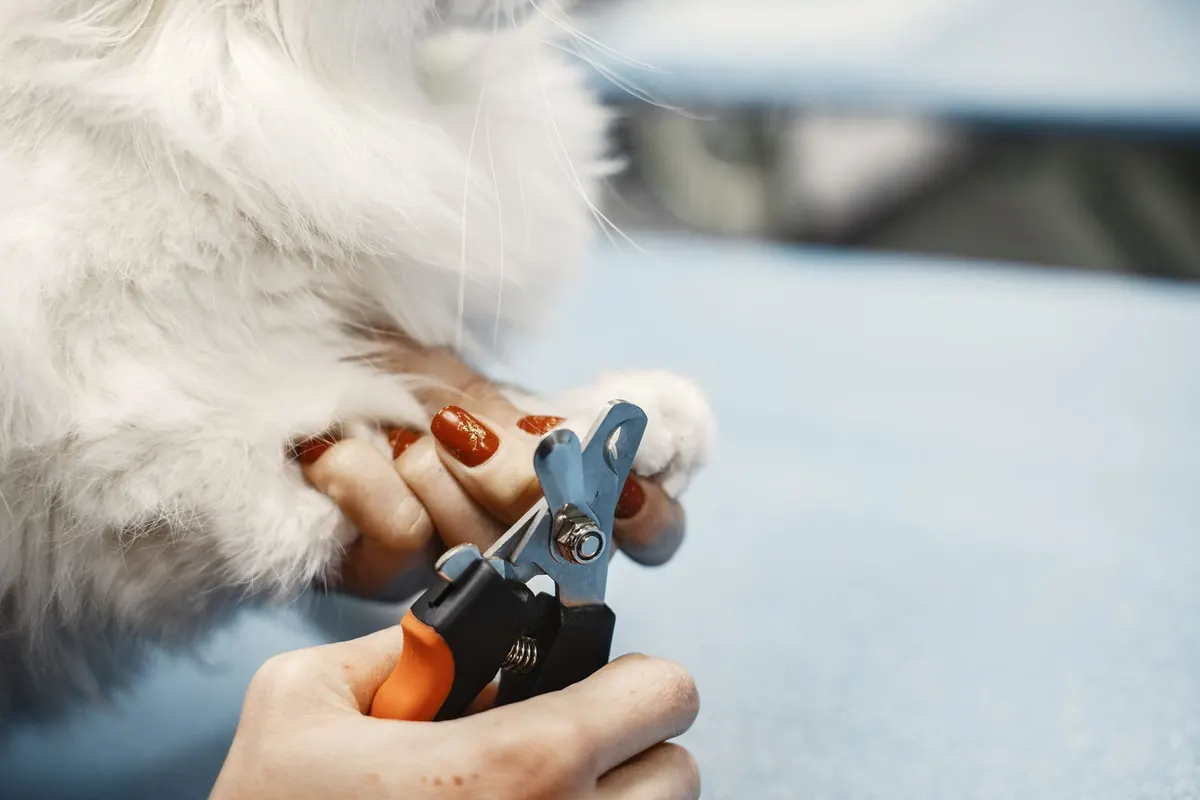
- Sharp clippers made for cats. Scissor-style or guillotine clippers both work. Dull blades crush the claw instead of slicing it, which causes splitting and makes the whole experience unpleasant. Replace them when they start to drag.
- Styptic powder or plain cornstarch. If you nick the quick, this stops the bleeding fast. Keep it open and ready, not buried in a cupboard.
- High-value treats. Freeze-dried chicken, a lickable tube treat, anything she doesn't get every day.
- A towel. Useful for wrapping a wriggly cat or for a lap barrier if she's prone to kneading.
- Good light. A desk lamp or a bright window beats a dim living room every time.
Pick Your Moment
Timing does more for your success rate than any trick. The best window is right after a solid play session, when your cat is warm, stretched out and slightly lazy. A cat dozing on the couch is also fair game. A cat who just woke up, just came home from the vet, or is mid-zoomies is not.
Try to trim in the same spot every time, ideally somewhere calm and non-slip. Bathrooms are popular because they're easy to clean and hard to escape, but the echo and cold tile stress some cats out. A rug in a quiet room often works better. If your cat is deeply unhappy on the floor, try a counter at waist height, which many cats tolerate because they feel less trapped.
How to Hold a Cat for a Trim
You don't need to pin your cat down. You need to support her so she can't back away.
- Sit on the floor or a couch with your cat in your lap, facing away from you.
- Tuck her body gently against your stomach with your non-dominant arm. Her back paws rest on your thigh.
- With that same hand, press the pad of one toe between your thumb and forefinger. The claw slides out.
- Trim that claw, give a treat, then move to the next toe on the same paw.
If your cat squirms hard, ask someone to help. One person holds and offers treats while the other trims. For a cat who truly hates being held, wrap her in a towel with one paw poking out, snug but never tight, and release the paw between nails.
Where to Cut and How Much
Look at the claw. On white and light-colored nails you'll see a pink core running down the middle. That's the quick, and it contains blood vessels and nerves. Cut two to three millimeters past it, straight across or at a slight angle following the claw's curve. Never cut down the sides of the claw, which is where the quick sits closest to the surface.
Dark claws hide the quick, so trim in thin slivers and check the cut end each time. When you get close, the center turns from solid dark to a chalky white or grey ring. Stop there. When in doubt, cut less. A slightly long nail is not a problem. A bleeding one sets you back weeks.
If you do nick the quick, stay calm. Press styptic powder or cornstarch onto the tip and hold firm pressure for thirty seconds. Your cat will yelp, and then she'll take a treat. Don't scold her, and don't rush to finish the paw. Call it a day.
When Your Cat Won't Cooperate
Some cats simply won't tolerate a full trim in one sitting, and that's fine. Work backwards: do one nail today, another tomorrow. Spend a week just touching and squeezing her toes during relaxed moments, pairing every touch with a treat, and trim nothing at all. Most cats come around once they learn that paws being handled predicts chicken.
Never push through a full-blown panic. If she's flailing, hissing or trying to bite, stop and try again tomorrow. Forcing it teaches her that clippers mean a fight, and that lesson sticks. If you've tried for weeks with no progress, a vet or groomer can trim the claws, and many will show you their handling technique while they do it.
One last note: declawing is a surgical amputation of the last bone in each toe, and it isn't recommended as a routine solution for scratching. If scratching is your main concern, ask your vet about soft nail caps and set up a few sturdy scratching posts instead. For anything that looks painful or infected, or if your cat has a health condition that affects her paws, get professional advice rather than guessing.
Make It a Routine, Not a Battle
The cats who sit quietly for trims are almost never naturally calm. They've just had the same short, treat-filled routine repeated enough times that it stopped being scary. Aim for two minutes, four paws a week apart, and finish every session while your cat still wants more. Trim only what you can do calmly, reward generously, and put the clippers away before she's had enough. Do that for a month, and the scratched-forearm era of claw trimming ends quietly, with both of you on the couch and a treat in hand.
Photo: Gustavo Fring / Pexels